For more than a decade, personal injury firms had a dependable playbook: publish helpful content, rank for the questions accident victims were asking, and turn some of that traffic into signed cases. That playbook is breaking, and the cause isn’t a competitor. It’s Google.
Google’s AI Overviews now answer many injury-related questions right on the results page. When someone searches “how much is my car accident case worth” or “do I need a lawyer after a rear-end collision,” they often get a full answer without visiting a single law firm website. For firms that built their pipeline on organic traffic, that’s a real problem.
What the data shows
The numbers from the last 18 months are hard to ignore:
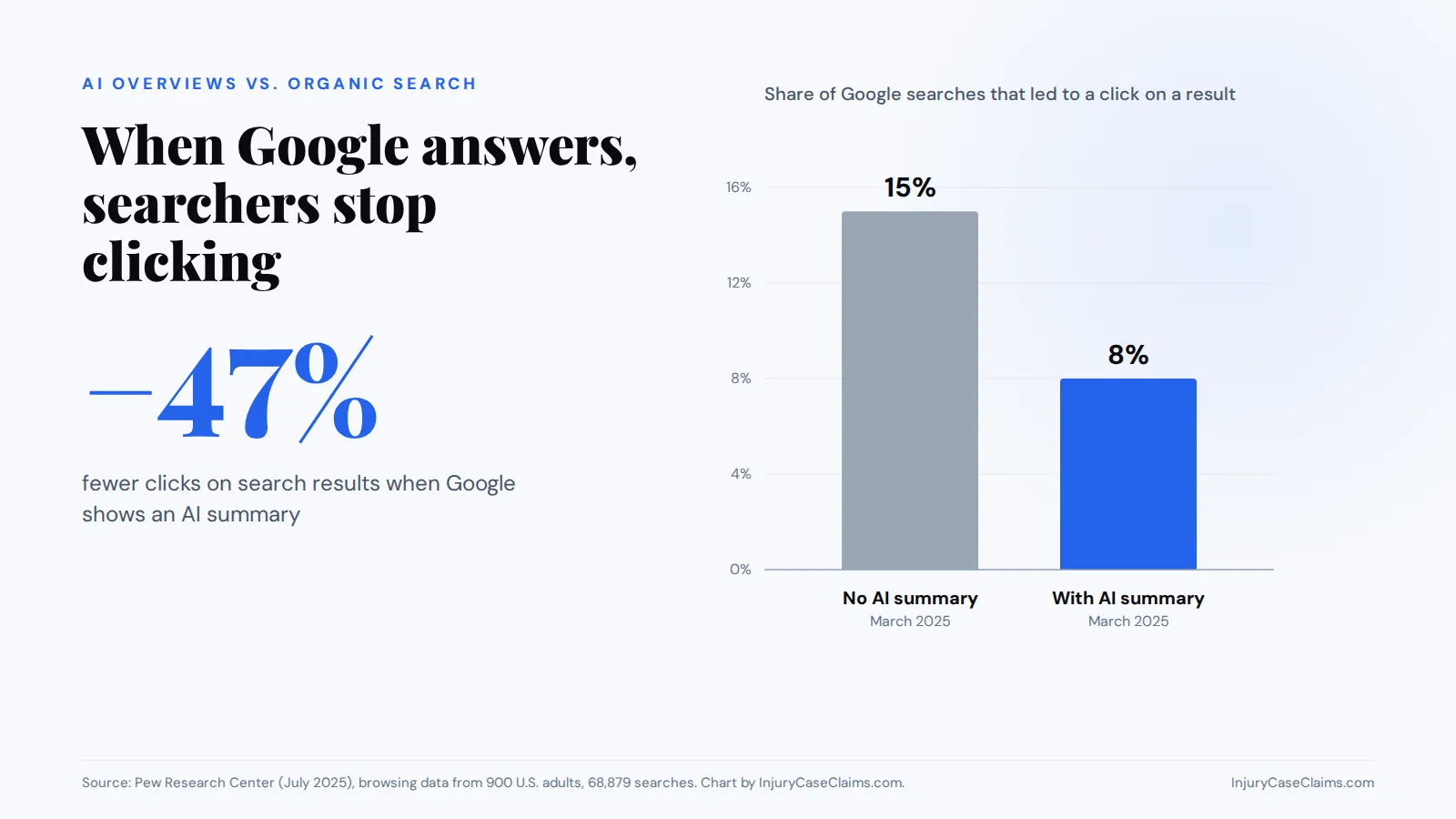
- Clicks drop by roughly half when an AI summary appears. A Pew Research Center study of 900 U.S. adults found users clicked a traditional search result on 8% of visits when an AI summary appeared, compared with 15% when it didn’t. Only 1% of visits included a click on a link inside the AI summary itself.
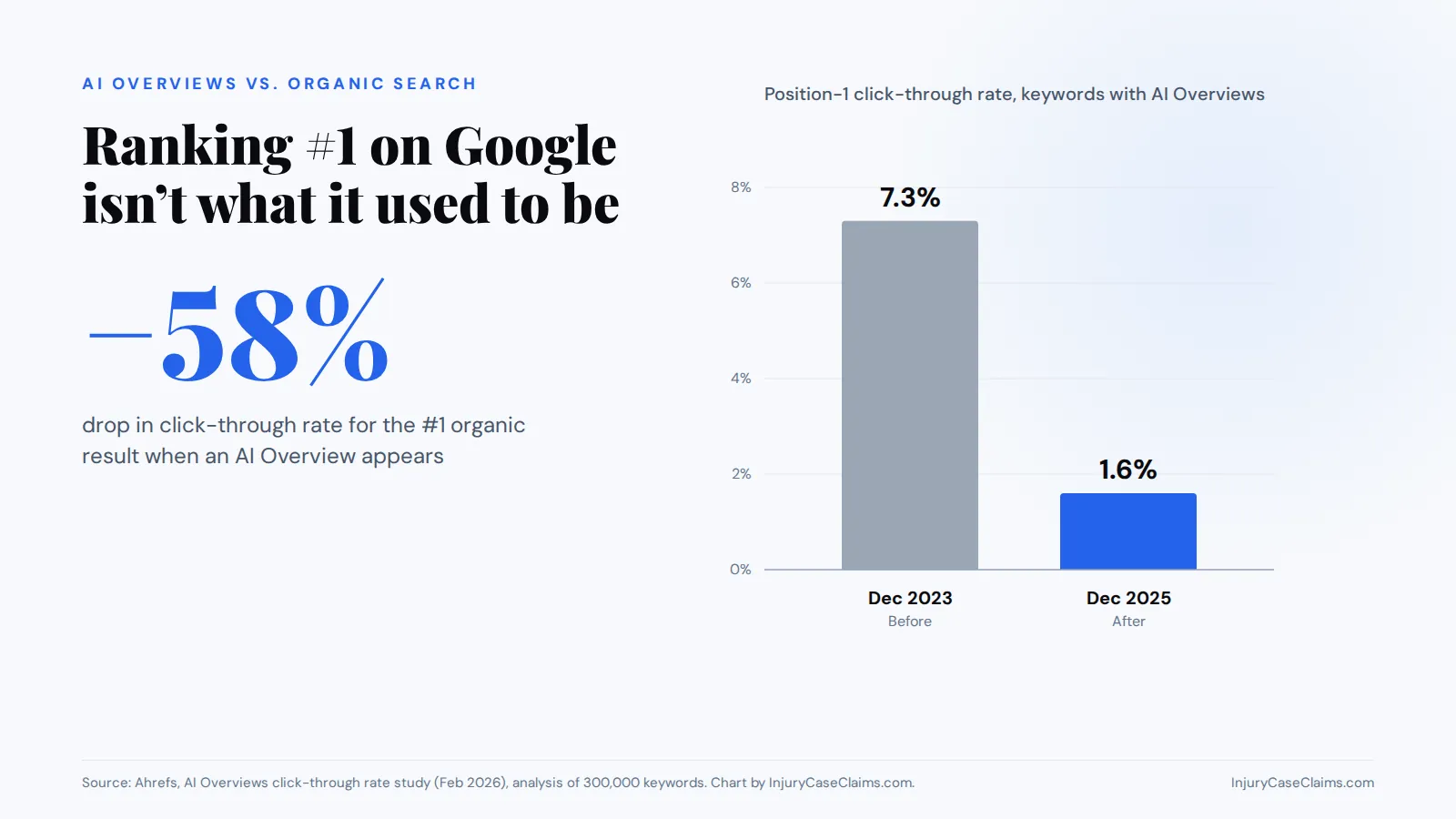
- The #1 ranking is worth far less than it used to be. Ahrefs’ February 2026 analysis of 300,000 keywords found that position-one click-through rate on queries with an AI Overview fell from 7.3% to 1.6% between December 2023 and December 2025, a 58% reduction.
- Legal is one of the most exposed categories. Industry analyses estimate that around 78% of legal queries now trigger an AI Overview, putting legal among the most affected verticals.
Ranking first on Google used to be the finish line. Now it’s the entry fee, and the prize is smaller.
Why personal injury gets hit harder
Not every law firm feels this equally. A corporate client searching for a specific firm by name still clicks through, and branded searches have held up fairly well.
Personal injury is different, because PI SEO was built on informational content:
- “What to do after a car accident”
- “How long does a personal injury settlement take”
- “Average settlement for a slip and fall”
- “Statute of limitations for personal injury in Texas”
These are exactly the questions AI Overviews answer completely. The accident victim gets a tidy summary, feels informed, and often never reaches the firm that wrote the original article — even when that article is what Google summarized. The top-of-funnel traffic that used to warm up future clients is being intercepted before it reaches you.
Paid search is getting squeezed too
The obvious response is “we’ll just buy the traffic.” Every other firm in your market is thinking the same thing.
- WordStream’s 2026 benchmarks put Attorneys & Legal Services at $9.87 per click, the highest of any industry tracked and up about 15% year over year.
- That blended average understates what PI firms pay. High-intent terms like “car accident lawyer near me” in competitive metros routinely run $150 to $300+ per click.
- The legal industry’s average cost per lead was about $131 in 2025, nearly double the cross-industry average.
The organic funnel is shrinking while the paid funnel gets more expensive. Firms are paying more at both ends, and none of it guarantees a signed retainer.
SEO isn’t dead, but its job has changed
SEO still matters. Your firm still needs:
- A strong Google Business Profile and local pack presence, because “near me” searches still drive calls
- Branded search visibility, so people who hear about you can find you
- Authoritative content that AI tools cite, because being named as a source in an AI answer builds credibility
What has changed is the return-on-investment timeline. Organic content used to be the cheapest source of cases over the long run. Now a firm can spend 12 to 18 months building rankings, only to find the traffic those rankings deliver has been cut in half by the time they arrive. For a firm that needs cases this quarter, that’s a hard bet to make alone.
Why firms are adding case acquisition
That’s why more PI firms are shifting part of their budget from attracting traffic to acquiring cases directly, working with plaintiff acquisition partners who handle the marketing, intake and screening, then deliver pre-qualified claimants.
- You pay for qualified claimants, not clicks. Whether Google sends 100 clicks or 40 becomes the acquisition partner’s problem, not yours.
- Volume is predictable. You can plan staffing, intake and case load around a committed volume rather than hoping this month’s rankings hold.
- Geographic precision. Target the exact states and markets where you’re licensed. Firms growing in high-cost markets like Houston, Dallas and San Antonio can source Texas MVA leads without competing in some of the most expensive PPC auctions in the country. We also run MVA programs in Florida, Georgia, New York and Pennsylvania.
- Speed to market. A new office or practice area can start receiving cases in weeks, not the year it takes to build organic authority.
- It complements SEO instead of replacing it. Many firms keep investing in brand and local SEO for long-term equity while using case acquisition to fill the gap AI search has opened.
What to look for in a case acquisition partner
Not all lead sources are equal, and the stakes for your firm are high. Before you sign with any vendor, ask:
- Are leads exclusive or shared? Shared leads mean you’re racing other firms to the phone.
- How is consent captured and documented? You want timestamped consent records, the exact disclosure language and source URLs on file. TCPA exposure follows the calls your firm makes.
- Is the advertising compliant in your states? The rules are moving fast. California’s SB 37 now holds firms liable for their vendors’ marketing, and Colorado’s SB 26-174 bans paying per lead outright.
- What qualification criteria are used? Liability, injury severity, treatment status, existing representation and statute of limitations.
- Is there a replacement policy if a lead turns out to be unqualified?
- How fast is delivery? Contact rates fall sharply after the first few minutes, so real-time delivery matters.
Know your state before you buy. In states like Colorado, the compliant model is a marketing partner working on behalf of a clearly identified firm, paid for services and media rather than per lead. A good partner will structure the program around your jurisdiction, not the other way around.
The bottom line
AI Overviews haven’t made personal injury marketing impossible. They’ve made organic traffic alone more expensive and less predictable. Firms adapting fastest are treating SEO as a brand asset and using direct case acquisition to secure what keeps a PI practice running: a steady flow of qualified claimants.
Ready to see what case volume looks like in your market? Explore our MVA leads program or check current availability for Texas MVA leads.
Frequently asked questions
Are AI Overviews reducing traffic to law firm websites?
For many firms, yes, especially personal injury firms that rely on informational content. Research from Pew and Ahrefs shows organic click-through rates fall sharply when an AI Overview appears, and legal queries trigger AI Overviews at one of the highest rates of any industry.
Should personal injury firms stop investing in SEO?
No. Local SEO, Google Business Profile and branded search still drive valuable calls. But many firms are rebalancing their budgets, because informational content no longer delivers the traffic it once did.
What’s the difference between buying clicks and case acquisition?
With PPC, you pay for every click, whether or not it becomes a client. With case acquisition, a partner handles marketing and intake and delivers pre-screened claimants, which moves much of the traffic and conversion risk away from your firm.
Sources
This article is general information, not legal advice. Lead generation and attorney advertising rules vary by state; take your specific campaigns to your own counsel for a formal opinion.
Back to Blog